
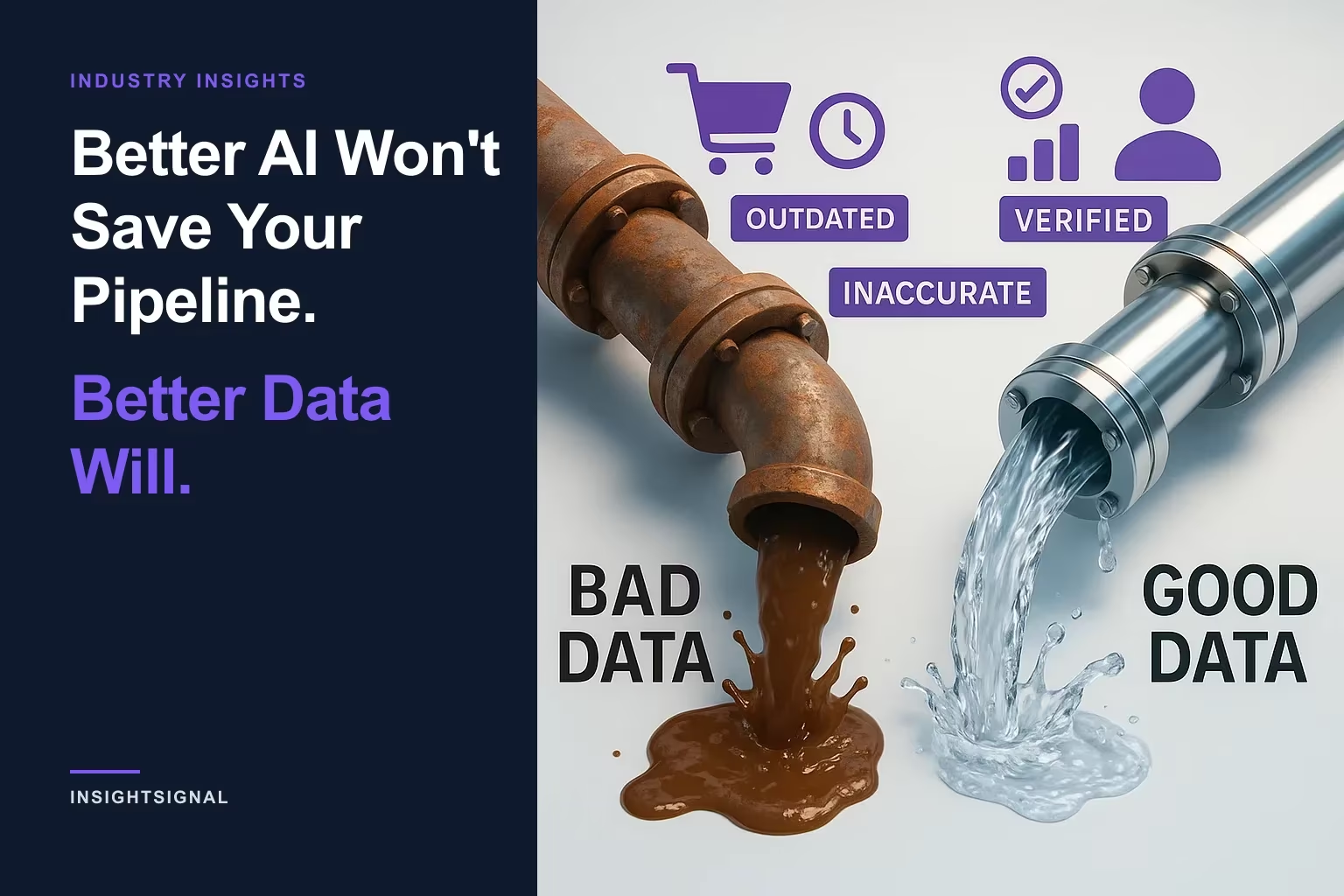
Better AI Won't Save Your Pipeline. Better Data Will.
What McKinsey's AI Transformation Manifesto means for revenue leaders — and the five themes that actually decide whether your pipeline AI program earns its budget.
Twelve themes, and the part GTM leaders should read twice
In April 2026, McKinsey's QuantumBlack group published The AI Transformation Manifesto — twelve themes distilled from the second edition of their book Rewired and hundreds of large-scale AI rollouts. The headline numbers are the part everyone is already circulating: the leading companies McKinsey studied delivered an average 20% EBITDA uplift, reached breakeven in one to two years, and generated $3 of incremental EBITDA for every $1 invested.
The part that gets less attention is the qualifier — those returns went to companies that concentrated on one to three business domains, not the long use-case lists most boards are still approving. For revenue and GTM leaders, the manifesto reads like every other transformation playbook until you look more carefully. Five of its twelve themes are the ones that actually decide whether your pipeline AI program earns its budget or quietly dies. Those five are what this piece is about.
The manifesto in 30 seconds
McKinsey organizes the work around six capabilities — strategic road mapping, talent, operating model, tech, data, adoption and scaling — and twelve themes that sit on top of them. The throughline across all twelve is simple and uncomfortable: technology itself isn't the moat. Everyone has the same models. The moat is the set of enduring capabilities a company applies fast to the parts of the business that actually move the P&L.
For a GTM org, the manifesto's five most load-bearing themes are data (theme 8), value (theme 3), trust (theme 10), adoption (theme 9), and agentic engineering (theme 11). The other seven matter — but those five are where revenue leaders own the decision.
Theme 8: Your AI is only as smart as the data you feed it
McKinsey leans on a quote from David Baker, the 2024 Nobel laureate in Chemistry, that should be the bumper sticker for every Q3 GTM planning meeting: "AI needs masses of high-quality data to be useful." Most revenue pipelines run on stale, generic, undifferentiated CRM records. Layering AI on top of that doesn't produce insight — it produces confident-sounding noise, faster. The score is wrong, the email is generic, the cadence is undifferentiated, but everything looks more sophisticated than it did six months ago. This is the trap McKinsey describes when it observes that "in most organizations, data often still acts as the constraining factor."
The manifesto's prescription is two-stage. First, productize data — make it easy to discover, access, and consume across many AI-powered applications. Second, enrich it for advantage — deepen its quality, context, and uniqueness for sustained performance gains. This is the gap InsightSignal closes for revenue teams. Thin prospect records go in. Verified, personalized signals come out: a persona-fit grade, intent reasoning, contextual evidence — fields a downstream tool or a human can actually act on. "Every insight, verified" isn't a tagline; it's what theme 8 looks like when you run it inside a sales organization.
Theme 3: If it doesn't move the business, you're getting it wrong
McKinsey's bar is concrete: 20% EBITDA uplift, $3 per $1, breakeven in one to two years, drawn from twenty industry leaders. The GTM versions of those metrics aren't mysterious either — pipeline velocity, SDR meetings booked per rep, conversion on prioritized accounts, ACV uplift, win rate.
The failure pattern the manifesto calls out — and that every revenue leader sees — is teams investing real money in AI projects that improve a number nobody on the P&L recognizes. "We increased lead-scoring accuracy by 14%." Fine. Did pipeline grow? Did reps book more meetings? Did the CFO notice the EBITDA line move? If no, you optimized a model, not a business. The discipline is straightforward and rarely practiced: pick one revenue KPI. Tie every AI-generated signal to it. Report the lift quarter over quarter using a denominator the CFO recognizes. InsightSignal closes this loop directly — conversion outcomes are tied back to scored accounts inside the product, so the team running it can answer the question McKinsey says most AI deployments never answer: did this actually work?
Theme 10: No trust by your reps, no right to deploy
McKinsey frames trust externally — customers, regulators, employees, partners, society at large. "When AI systems fail, they challenge trust" with all of them. For a revenue leader, there's an even more immediate version of that sentence: no trust by your own sales reps, no right to deploy.
Every CRO has watched this play out. A black-box score lands in the rep's queue. The rep doesn't believe it. They work their own list. Adoption dies on the floor, no matter how good the underlying model was. This is where verified beats predicted. InsightSignal exposes the reasoning behind each grade — the rep can read why this account ranks high, not just that it does. The score becomes legible, which is what makes it usable. Theme 10 says trust is what earns the right to deploy AI at all; in GTM, that right is granted or denied by sales reps long before any customer sees it.
Theme 9: Design for adoption, build for scale
The most quotable line in the manifesto comes from theme 9: "An AI solution may predict equipment failures days in advance, but if maintenance still follows calendar-based scheduling, nothing happens." The GTM mirror of that line is uncomfortable. You can score every lead with state-of-the-art models, but if reps still work the top of their list alphabetically — or if marketing's nurture cadence ignores the score — your AI changed nothing.
Adoption is a process problem, not a tool problem. Cadence, sequencing, SDR-to-AE handoff, and manager coaching loops all have to bend around the new signal. McKinsey calls this a "well-choreographed dance between central teams and the receiving units." For a revenue org, the receiving units are field reps and frontline managers, and they don't dance unless the choreography is built into the tools they already use. That's the design constraint InsightSignal is built around: it lives inside the CRM and outbound workflows reps already work in. It's designed to be adopted, not negotiated with.
Theme 11: Agentic engineering is the next compounder
The manifesto names agentic engineering as the next capability to master. McKinsey is direct: foundation models are now capable of sustained, autonomous work over long periods, and Rewired companies "consistently absorb new technologies faster because they've built the underlying capabilities to do so." The GTM read on theme 11 is that the next eighteen months will separate revenue teams whose agents can independently research accounts, draft personalized outreach, qualify inbound, and update CRM state — from teams still routing every signal through a human triage step.
InsightSignal is already an agentic workflow under the hood: each scored account is the output of a multi-step research-and-reasoning pipeline, not a static lookup. Theme 11 isn't a future ambition for us; it's the architecture. McKinsey adds the right warning, too: "the excitement for agentic AI may be getting ahead of companies' ability to manage the more complex risks." Translated for revenue teams — agents that send outbound on your behalf will eventually represent your brand badly if they're built on bad data and weak guardrails. Themes 8 and 10 are the prerequisites for theme 11. You don't get to deploy agents on a foundation you don't trust.
The shortlist for revenue leaders
Twelve themes is a lot. The five that matter for revenue and GTM organizations are the ones we've walked through here:
- Theme 8 — Data. Fix the input or stop blaming the model.
- Theme 3 — Value. Tie every signal to a revenue KPI the CFO recognizes.
- Theme 10 — Trust. Make the score legible, or your reps will ignore it.
- Theme 9 — Adoption. Redesign the cadence around the signal, not the other way around.
- Theme 11 — Agentic. Earn the right to deploy agents by getting the first four right.
The companies that win the next twenty-four months won't have better AI than you. They'll have better-fed AI — running on data that's been productized, enriched, and verified, inside processes designed to consume it. That's the manifesto's bet. It's also the product brief for InsightSignal. See it in action at signal.insightopus.com or book a demo.
Sources
Copyright © 2024–2026 InsightOpus Inc.